
My
country Nepal is rich in natural beauties. I have heard about Manang Mustang
since childhood. So, I have been talking about trekking to Mustang with my
friends since many years. And then we formed the hiking group consisting 5
members including me, my sister Jeena, my friends Sangarshila, Sachin and
Chetna. We planned our trip for October 2nd 2015 but unfortunately
we postponed it. Now we added Manang to our trip this time and that was our
wonderful decision. At first we were so confused to start our trek and we did
lots of research and collected so many information from our relatives, friends
and internet. Then we started shopping for our trek that was a fun, we were so
excited to start our trek. My parents was not happy by my decision and they
tried to stop me but I didn’t.
We
left our home at around 2 pm on Friday October 30 and get into the microbus and
headed toward Lamjung, we were so happy. But our bad luck, our microbus was
trapped in checking at Aaptari, Chitwan and we were carried to police station
from check post. Our fault was we didn’t asked for ticket, we were in problem
now. We had a bad experience with police inspector on that day. Finally, we
caught bus for Dumre as we didn’t have direct bus to Lamjung. Fortunately we
met some good people and reached to our destination safely at around 10 pm. We
stayed at Hotel Mongolian, Besishar, Lamjung on that day which was booked by
Raju Dai who was my neighbour. I called to my parents after reaching there,
they were so worried about me because they loves me so much.
Next
morning we hired a jeep to go to Chame and luckily we got chance to mix up with
other group. On the way we did lunch together at hotel waterfall guest house
and restaurant. After some time we reached Syange and saw waterfall which was
so beautiful and we stopped there for some time, took photos. From there we walked short distance and that
was really a fun walking with new members. We introduced with each other during
the walk. Among them one was DSP from Kathmandu named Arjun Timilsina, next was
Surendra KC who was his friends, another was Rajendra Adhikari and he was
inspector from lamjung, next was Hom dai, Barun dai, Bikas dai, Niranjan dai,
Avivandhana Di and Shaswat dai who used to keep silent. After few minutes we
found another waterfall which was amazing and was on the side of a road.
 As we
didn’t knew its name we named it Bahubali Jharana as we have seen such type of
waterfall in the movie Bahubali. After
going ahead, we have reached to a place named Taal, which was a piece of
heaven. We crossed so many beautiful places n views on the way that was my best
experience. But road was very scary, so this trip was full of adventure for us.
In this way we reached Chame, it took about 8 hours. After reaching there we
stayed in another hotel had a dinner. On that day fortunately we got chance to
watch cultural dance of Manang district as well.
As we
didn’t knew its name we named it Bahubali Jharana as we have seen such type of
waterfall in the movie Bahubali. After
going ahead, we have reached to a place named Taal, which was a piece of
heaven. We crossed so many beautiful places n views on the way that was my best
experience. But road was very scary, so this trip was full of adventure for us.
In this way we reached Chame, it took about 8 hours. After reaching there we
stayed in another hotel had a dinner. On that day fortunately we got chance to
watch cultural dance of Manang district as well.


On
fourth day, we waked up had a breakfast and walked ahead to Shree Khadga, again
we have to cross a bridge and that was so scary for me but any how I passed it
with the help of Surendra KC to whom I used to call mamashree as he was from my
mawali place Banepa. We reached Shree khadga, took rest clicked some pictures
of mountains and Annapurna range which was so near to us as if I can touch it..
Those views were really awesome. Our team member had a lunch there they ate
rice and we five girls ate thukkpa as we didn’t liked rice. After lunch we
headed toward Tilicho base camp (TBC). On that day I was fresh and enjoyed our
walk. I was surprised of my sister as I thought she couldn’t walk but she was doing
well, was enjoying the trek and was leading our group. I was always scared of
bridge and every time I took help of friends. Now this time we had to cross
landslide area and the route was very dangerous. We had to walk through
Marsyangdi River and if we fall down from our trail we have to swim in that
river, but the views were lovely and that was a thrilling experience for us. On
that way I was with my Surendra mama, Shaswat Dai n Shangarshila, they helped
me a lot. Anyhow we crossed that trail and reached base camp safely after walking
about 10 hours. That place was so pleasant, surrounded by snow and snow-capped
mountains. We drink hot water and ginger garlic soup after reaching there. We
started planning to go to Tilicho Lake which is situated at highest altitude
(5200 meter). Arjun dai was now confused to take us up to Tilicho Lake as we
were not well prepared, we don’t have cramp-pones which was essential to walk
on snow as the way was slippery. So all of us were tensed, I loosed my
confidence to go there, I thought
Tilicho Lake is next to impossible for me. So I was convinced not to go
there. My other friends those who don’t have cramp-pones were also so confused,
but they decided to go anyhow. We had a lunch, played card, sang a song sitting
beside wood fire, as it was very cold weather. And all of us slept at dining
hall including foreign tourist. Hall was so crowded, there was not sufficient
blanket and pillow, so could not sleep well. Niranjan dai is very humorous
person, he always crack jokes and make us laugh. He said I need a pillow, and everybody
started laughing and barun dai said “तपाईं को ससुरली होर भनेको भनेको जस्तो गरी बस्न पाउनलाई”, we start to laugh again. But internally I was very
sad as I have decided not to go Tilicho Lake, tears were rolling down from my
eyes whole night and couldn’t sleep.


This
was fifth day, everybody waked up and was getting ready. Poor me, I was not
going so I was sitting on the bed. But Shaswat dai n Bikas dai gave confidence,
encouraged me and told they will take me there. I was so happy and made my mind
to go. And we moved ahead at around 5 am, I was following Shaswat dai, trail
was very dangerous, it was covered by snow, slippery, very narrow and again we
have to cross landslide area. Stones were falling down, so we had to cross it
as soon as possible, and I was hited by stone badly. I slipped down 2-3 times
due to slippery snowy way, so Shaswat dai gave his cramp-pone and his
original stick without thinking about own self. I was so grateful to him at
that time, I felt as if god has send him there just to save me. He is really
helpful, responsible, and humble. He is very strong, for me he is a super hero. On the way, we saw
the board 35 minutes more to Tilicho Lake. At that time I was with Shaswat dai
and Jeena. In this way we reached our destination
Tilicho Lake after walking about 5 hours, it collects
the glacial melt of the entire northern slopes of Annapurna and Thorang Peak,
which is claimed to be the highest lake in the world. In 2001, Hindu pilgrims
from around the world flocked to the lake convinced it is a holy spot mentioned
in the Ramayan - a holy book of the Hindus. Tilicho
Lake was so beautiful, offering us spectacular and majestic view of white
Himalayas.
 We were so happy, feeling proud to be at highest altitude. We
clicked so many photos, enjoyed with nature. And after few minutes I felt
uneasy, I had a severe headache and nausea. I couldn’t drink or eat anything at
that place, I guess I was caught by AMS. So Shaswat dai told us to move down
and we headed back from there. Every time he was with me so that he can take
care of me, this time also I was using his cramp-pone and his stick. On the way
he told that today is his special day and I asked is it your birthday? He just
smiled and said I will tell you tomorrow. After some time we met Bikas dai who
was walking in front of us and Shaswat dai said Bikas dai to take care of me
and he walked ahead. Now I was walking with Bikas dai, he was also very good
person, every time he used to encourage me. Avee di was resting on the way as
she was suffering from migrain headache. Finally we get
back to TBC safely. I thanked god for helping me by sending peoples like
Shaswat dai and his friends in my life. When we reached TBC I found Arjun dai
sleeping on the floor, as he was caught by AMS, my sister gave him blanket and
some medicine. Now I was fine and ate wai wai soup. But Arjun dai was not
feeling well so we decided to stay at TBC. After having dinner, we sat down
around wood fire and start our regular chitchats and songs. Some of my friends
were playing card. Suddenly, Sangsharshila asked Shaswat dai his cast and he
said Shrestha, I was shocked as he didn’t look like newar. During our chitchat
he told his house was in Thamel, Kathmandu. And I asked him do u have a sister
named Laghu and he said yes, than I was confirmed that he is my relative. He
asked my father’s name and I told him his name is Ganesh Lal Shtrestha. At that
time I was so glad to find my mama at that unknown place. All my family members
knows him only I have never met him before so I didn’t recognized him. At that time I realized that I am very
lucky girl. I was so excited and I called to my home and told about Shaswat
dai who was my mama. My parents were also happy and now they were relaxed. I
could not sleep that night also, may be because of high altitude and
excitement.
We were so happy, feeling proud to be at highest altitude. We
clicked so many photos, enjoyed with nature. And after few minutes I felt
uneasy, I had a severe headache and nausea. I couldn’t drink or eat anything at
that place, I guess I was caught by AMS. So Shaswat dai told us to move down
and we headed back from there. Every time he was with me so that he can take
care of me, this time also I was using his cramp-pone and his stick. On the way
he told that today is his special day and I asked is it your birthday? He just
smiled and said I will tell you tomorrow. After some time we met Bikas dai who
was walking in front of us and Shaswat dai said Bikas dai to take care of me
and he walked ahead. Now I was walking with Bikas dai, he was also very good
person, every time he used to encourage me. Avee di was resting on the way as
she was suffering from migrain headache. Finally we get
back to TBC safely. I thanked god for helping me by sending peoples like
Shaswat dai and his friends in my life. When we reached TBC I found Arjun dai
sleeping on the floor, as he was caught by AMS, my sister gave him blanket and
some medicine. Now I was fine and ate wai wai soup. But Arjun dai was not
feeling well so we decided to stay at TBC. After having dinner, we sat down
around wood fire and start our regular chitchats and songs. Some of my friends
were playing card. Suddenly, Sangsharshila asked Shaswat dai his cast and he
said Shrestha, I was shocked as he didn’t look like newar. During our chitchat
he told his house was in Thamel, Kathmandu. And I asked him do u have a sister
named Laghu and he said yes, than I was confirmed that he is my relative. He
asked my father’s name and I told him his name is Ganesh Lal Shtrestha. At that
time I was so glad to find my mama at that unknown place. All my family members
knows him only I have never met him before so I didn’t recognized him. At that time I realized that I am very
lucky girl. I was so excited and I called to my home and told about Shaswat
dai who was my mama. My parents were also happy and now they were relaxed. I
could not sleep that night also, may be because of high altitude and
excitement.

Next
morning (sixth day), we did breakfast and headed back to Shree khadga. As I
have already described the way was very dangerous but this time I was with my
own mama so I was feeling safe. On the landslide area as the trail was so
narrow, I was scared to step my feet but I crossed it with my two mama. Infront
of me I have Surendra mama n Shaswat mama at my back.
 Beside them Sudip bhai
who has joined us from Shree khadga, Jeena and Arjun dai was also walking with
me. Shangarshila and Barun dai was walking ahead. Other group members were at
my back. We had lunch at Shree khadka and headed toward Yak Khadka. On the way
we can see forts and snow-capped mountains, below there was Marsyangdi River.
Beside them Sudip bhai
who has joined us from Shree khadga, Jeena and Arjun dai was also walking with
me. Shangarshila and Barun dai was walking ahead. Other group members were at
my back. We had lunch at Shree khadka and headed toward Yak Khadka. On the way
we can see forts and snow-capped mountains, below there was Marsyangdi River.
 Again we have to use cramp-pone, and I got it from Shaswat mama. This day we
walked for about 10-11 hours. Now my feet started hurting I felt as if I
couldn’t walk more. Finally we found one small restaurant and I thought we were
staying there as it was already dark. But Barun dai told we have to walk
more, and I was tired and was scared to walk at night so I said no. I could not
control myself and I started crying and that was my most embracing moment. Oh
my god how could I cry infront of my friends and other member of our group like
a small baby. So ever body stayed there but Arjun dai, Surendra mama and Sudip
bhai had already gone so me missed them, they stayed at Yak Khadga. We did camp
fire, and had a lunch. I found caring
and sweet Avee di, who was making me comfortable, we shared our dinner that
night. At that moment I felt as if I am being burden to my group members. My
sister and Shangarshila were also confused and finally we decided to come back
from there, but we were not happy at that moment. There was no sufficient space
and bedding so it was very difficult for us to sleep, this was all because of
me. I couldn’t sleep that night also.
Again we have to use cramp-pone, and I got it from Shaswat mama. This day we
walked for about 10-11 hours. Now my feet started hurting I felt as if I
couldn’t walk more. Finally we found one small restaurant and I thought we were
staying there as it was already dark. But Barun dai told we have to walk
more, and I was tired and was scared to walk at night so I said no. I could not
control myself and I started crying and that was my most embracing moment. Oh
my god how could I cry infront of my friends and other member of our group like
a small baby. So ever body stayed there but Arjun dai, Surendra mama and Sudip
bhai had already gone so me missed them, they stayed at Yak Khadga. We did camp
fire, and had a lunch. I found caring
and sweet Avee di, who was making me comfortable, we shared our dinner that
night. At that moment I felt as if I am being burden to my group members. My
sister and Shangarshila were also confused and finally we decided to come back
from there, but we were not happy at that moment. There was no sufficient space
and bedding so it was very difficult for us to sleep, this was all because of
me. I couldn’t sleep that night also.


On
seventh day, as we had decided to go home, I discussed our decision with my
mama and sadly he said as you wish. But at last Jeena changed her mind and she
decided to go ahead. Now Sangarshila and I was confused what to do, I could not
go back without my sister and I also wanted to pass Thorong-la peak, so we decided to move ahead.We were walking and the way was not so tough now, so
my mama walked ahead leaving me behind. We were moving ahead, but after some time I
became alone as other walked faster than me, suddenly there was two trail and no
directions. Now I was confused where to go, so I shouted calling Shaswat Mama
and my sister Jeena. But nobody replied, and I was afraid and start to cry
again. I just don’t know what to do, I start calling God, and after few minutes
may be about 10 minutes I saw my other friends Chetna, Sachin, Niranjan dai and
Avee di. They were just at my back and I asked them which one is the way and
they showed me the way. I moved ahead alone and few meter ahead I saw my mama
waiting for me and I was happy to see him waiting for me. He asked me did u
called me and I answered yes, and we start our walk talking with each other. He
told that day was his Birthday, and we shared so many things with each other.
In this way we crossed that trail and after some time Jeena also joined us and reached
Yak Khadka. We had a breakfast, charged our mobile and camera, also we bought
Cramp-pone at that hotel. After some time we again started our journey. Again we have to cross the bridge and I was afraid
to cross it. This time Bikas dai encouraged
me to cross it by myself and I boost up my confidence and I did it. Now I have
overcome my fear of bridge and credit goes to Bikas dai. Our friends were
waiting for us at Leddar for lunch and we joined them, I didn’t liked rice so
ate thukkpa. After lunch we moved ahead. Again we have to cross the bridge and this
time I did it myself and I was very glad. On the way there was a snow fall and
I was really enjoying that weather. I met Arjun dai, Surendra mama and Sudip
bhai on the way, and found them confused because of snow fall. I tried to
convince them to move ahead as we were so close to our goal. All my group members were behind
and I was waiting them at Thorong-la-base camp. After some time I found Bikas dai in-front of my
eye and after that Chetna and Sachin joined us. But my eyes was searching for
my sister and I was worried for her. After waiting sometime I saw Shangarshila and I asked where is Jeena. Finally I found her there and I
hugged her tightly in excitement. Slowly everyone joined us except three
peoples (Arjun dai, Surendra mama and Sudip). I asked mama about them and he
told they returned back home, I felt sad for them. Now we started planning for
Thorong-la Pass sitting beside wood fire, we planned to move at 4:30 am, had
dinner and went to our room. Jeena was not feeling well on that day, and mama
was observing her, and he was worried for her. I couldn’t sleep whole night, I
was just thinking about Thorong-la pass.
Finally,
the day has come and its eighth day, we packed our bags and get ready to go. All of us climbed up steeply with torch lights on our hand. After sometime we crossed High camp and we stopped for tea, at first tea shop
after high camp. And mama also arrived there, we three had a tea and moved
ahead.
 Finally we
were at 5416 meter height that means we achieved Thorong-la Peak, it was marked
by chortens and prayer flags. That was awesome feeling for us as we reached
their safely.I felt as if I was rewarded by magnificent view on the top. Now
we had a cup of tea and clicked some pictures at the top for memory. As that place was so windy it was difficult for us to
stay there and wait for others to come. So we stepped down toward holy town
Muktinath.
Finally we
were at 5416 meter height that means we achieved Thorong-la Peak, it was marked
by chortens and prayer flags. That was awesome feeling for us as we reached
their safely.I felt as if I was rewarded by magnificent view on the top. Now
we had a cup of tea and clicked some pictures at the top for memory. As that place was so windy it was difficult for us to
stay there and wait for others to come. So we stepped down toward holy town
Muktinath.
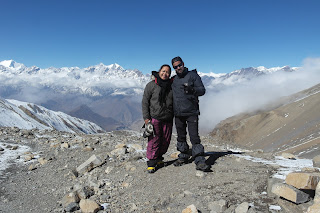


Among whole trip, for me this part was wonderful. We could see
awesome Dhaulagiri mountain range, I had a fun with snow, I was not scared
walking on the snow, we made snow man but it looked like snow ganesh. It took
about 4 hours to reach a restaurent at Muktinath for us, after reaching there
we ordered some drinks and I called at my home, proudly I told them that we
crossed thorong-la pass and they were really happy. We stopped there until all
our friends came. Finally all
other friends joined us, ordered food for them, after eating we left that
place. We booked a guest house and we stayed there. We did dinner together, and as everybody was
tired we went to our room and I had a sound sleep that day.

It was a 10th day, everyone waked up and mama was ready for
tarpan. We went to Kali Gandaki River with priest, mama did tarpan, Bikas dai
was there to help him. After finishing
all rituals we came back to hotel and had breakfast. Leaving Kaagbeni we
travelled down the Kali Gandaki river valley to Jomsom. We collected some
saligram on the river bank, we were enjoying beautiful landscape as well.
 We
walked for about 3 hours and reached Jomsom, where Shangarshila was waiting for us at Hotel Majestry. We had a delicious lunch and headed
toward Tatopani by bus and the way was very scary. Some of my friends started
drinking marpha in bus and they were
enjoying at that moment but I was so scared because of the way. After 7-8 hours
of travel we reached Tatopani and we had hot water bath and enjoyed a lot. We
had a dinner and slept.
We
walked for about 3 hours and reached Jomsom, where Shangarshila was waiting for us at Hotel Majestry. We had a delicious lunch and headed
toward Tatopani by bus and the way was very scary. Some of my friends started
drinking marpha in bus and they were
enjoying at that moment but I was so scared because of the way. After 7-8 hours
of travel we reached Tatopani and we had hot water bath and enjoyed a lot. We
had a dinner and slept.

Next morning (11th day) we did breakfast, packed our bags and
left Tatopani. We reached Beni after traveling for 4 hours and had our lunch,
all of us were very tired at that time. My sister’s feets were swollen as if
she was suffering from elephantiasis because of exhaustion. We booked a bus to
Pokhara, reached there at around 8 pm and get off from bus at Prithivichowk.
From there we headed toward our hotel and took rest. After some time we had
delicious dinner at Thakali hotel with all our friends including Bikas dai’s
wife and his son who joined us at Pokhara. We went to busy bee after dinner
enjoyed live music, played pushball, spent some memorable time as that was our
last night with soulful trekkers and get back to hotel and slept.
Finally on 12th day we packed our bags and headed toward
buspark with Chetna, Sangarshila and Jeena. Actually we were not happy to go
home as we were leaving our soulful trekkers back at Pokhara. After reaching
park Jeena and me get into the bus and came back home and Chetna and
Sangarshila went Kathamndu.
We felt that our trekking was really fruitful. We have widened and
depended our knowledge and experiences. Heartily writing, it is a piece of
heaven. I have realized that all of us should visit these places once in order
to illuminate our heart.


